

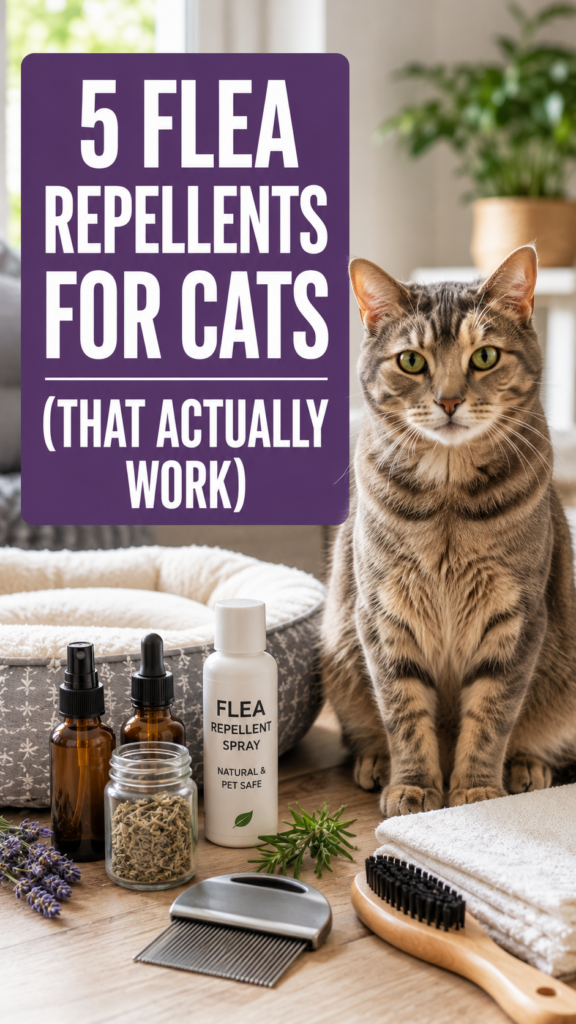
5 Flea Repellents for Cats (That Actually Work)
Watching my cat scratch over and over is one of the first signs that something isn’t right. That’s what led me to research 5 Flea Repellents for Cats (That Actually Work) after dealing with a stubborn flea problem at home. If you’re wondering which flea repellents are worth trying and which ones waste your time, you’re in the right place.
I quickly learned that getting rid of fleas takes more than treating your cat once. The best results came from using safe, reliable methods while keeping my home clean and staying consistent with care. These flea control tips have helped me reduce itching, keep my cat more comfortable, and make it much harder for fleas to return.
Save For Later
Key Takeaways
- Learn which flea repellents can help protect your cat.
- Understand why consistency is important for flea control.
- Reduce flea problems by treating both your cat and your home.
- Choose safe methods that are suitable for regular use.
- Stop flea infestations before they become harder to manage.
- Keep your cat more comfortable by reducing itching and irritation.
Pro Tip
One lesson I learned was to treat the environment at the same time as the cat. I vacuum carpets, wash pet bedding in hot water, and empty the vacuum right away after cleaning. I also check my cat with a flea comb every few days to catch problems early. Staying on a regular cleaning schedule made a much bigger difference than relying on a single product. Small, consistent steps have worked better for me than occasional deep cleaning.
Other Posts
- DIY Cat Food with Natural Taurine
- 3-Ingredient Chicken & Pumpkin Cat Food Recipe
- Homemade Tuna Cat Food Recipes
1. Flea Collars
Flea collars are one of the simplest options, and many cat owners like them because they’re low effort. Once you secure the collar around your cat’s neck, it slowly releases active ingredients that spread across the coat and skin. Over time, this creates a protective barrier that repels and kills fleas before they become a bigger issue.
I’ve noticed that collars are especially helpful for cats that go outdoors or spend time in areas where fleas are common. The long-lasting effect is what makes them appealing—you’re not reapplying something every week. Some collars remain effective for several months, which gives you peace of mind.
That said, not every cat tolerates collars well. Some will scratch at it or try to remove it. You also have to be careful about quality. Cheaper collars may not distribute the active ingredients properly, which reduces their effectiveness. When chosen carefully and fitted correctly—not too tight, not too loose—they can be a reliable long-term solution.
2. Topical Spot-On Treatments

Topical treatments are one of the most trusted solutions for flea control. You apply a measured dose of liquid to the back of your cat’s neck, usually between the shoulder blades where they can’t lick it off. From there, the medication spreads through the natural oils in your cat’s skin.
What I appreciate about spot-on treatments is how straightforward they are. You apply it once, and it continues working for weeks. It kills fleas on contact and, in many cases, also disrupts the flea life cycle by targeting eggs and larvae. That’s important because eliminating adult fleas alone isn’t enough—you have to break the cycle.
Most cats tolerate these treatments well, though occasionally some may experience mild skin sensitivity. It’s rare, but it’s something to monitor the first time you apply it. While they can cost more than collars, the effectiveness often justifies the price. If you want something dependable and widely recommended, this option consistently delivers results.
3. Oral Flea Medications
For cats that absolutely refuse collars and squirm away from topical applications, oral medication can be a game changer. These usually come in tablet or chewable form and are designed to be given monthly or as directed by a veterinarian.
Once swallowed, the medication enters your cat’s bloodstream. When fleas bite, they ingest the medication and die shortly after. What stands out to me about oral treatments is how fast some of them act. In active infestations, speed matters. Seeing relief within hours can make a huge difference for a miserable cat.
Of course, giving a cat a pill can be its own challenge. Some will swallow it easily when hidden in food, while others will detect it instantly and refuse. In most cases, these medications require a prescription, which means a vet visit. But if your cat resists other methods, oral medication can be one of the most effective and mess-free choices available.
4. Natural Flea Repellents

If you’re uncomfortable using stronger chemical treatments, natural repellents offer an alternative. I’ve found they work best as preventive measures or in mild cases rather than during heavy infestations.
Cedar oil sprays are commonly used because fleas dislike the scent, while many cats tolerate it well. A diluted apple cider vinegar solution can also be lightly applied to the coat. These methods don’t typically kill fleas instantly, but they help create an environment that fleas find less appealing.
Natural options tend to be more affordable and are often gentler for kittens or cats with sensitive skin. However, they require more frequent application and patience. If your home is already heavily infested, relying solely on natural remedies may not solve the problem. They’re most effective when combined with consistent grooming and environmental cleaning.
5. Flea Combs
Sometimes the simplest tools are still valuable. A flea comb has tightly spaced teeth designed to trap fleas, eggs, and flea dirt as you run it through your cat’s fur.
Using a flea comb takes time, but it gives you immediate visibility. You can physically see what you’re removing. I’ve found it especially useful when checking for early signs of infestation. Even if you’re using other treatments, combing helps monitor progress and remove lingering pests.
Keep a bowl of warm soapy water nearby while combing. After each pass, dip the comb into the water to drown any fleas you’ve collected. While combing alone won’t prevent fleas from returning, it’s completely safe, chemical-free, and suitable for cats of all ages—including kittens.
Final Thoughts of Flea Repellents for Cats
Fleas are persistent, and if you’ve ever dealt with them, you know they don’t disappear overnight. The key is choosing the method that fits your cat’s temperament and sticking with it. Some cats handle collars without issue. Others do better with spot-on treatments or oral medication. In certain cases, combining approaches gives the best protection.
What truly makes the difference is consistency. Skipping treatments or stopping too early allows fleas to rebound quickly. When you stay consistent and monitor your cat closely, you not only eliminate the current problem but also prevent it from returning.
A flea-free cat is more comfortable, more relaxed, and far less irritable. And when your cat feels better, your home feels better too.
All content on this site is written and reviewed by our experienced team to ensure it is accurate, reliable, and helpful for our readers. Our Our Process page explains how we carefully research and create high-quality content, while our Team page introduces the professionals behind our work. We also provide clear guidelines for content or image concerns on our Image Removal page, so you can trust that we prioritize transparency, quality, and reader safety.